Cloud or self-managed WMS: assign the operating responsibilities
Compare hosting responsibilities, upgrades, recovery, and integrations before selecting a cloud or self-managed warehouse system.
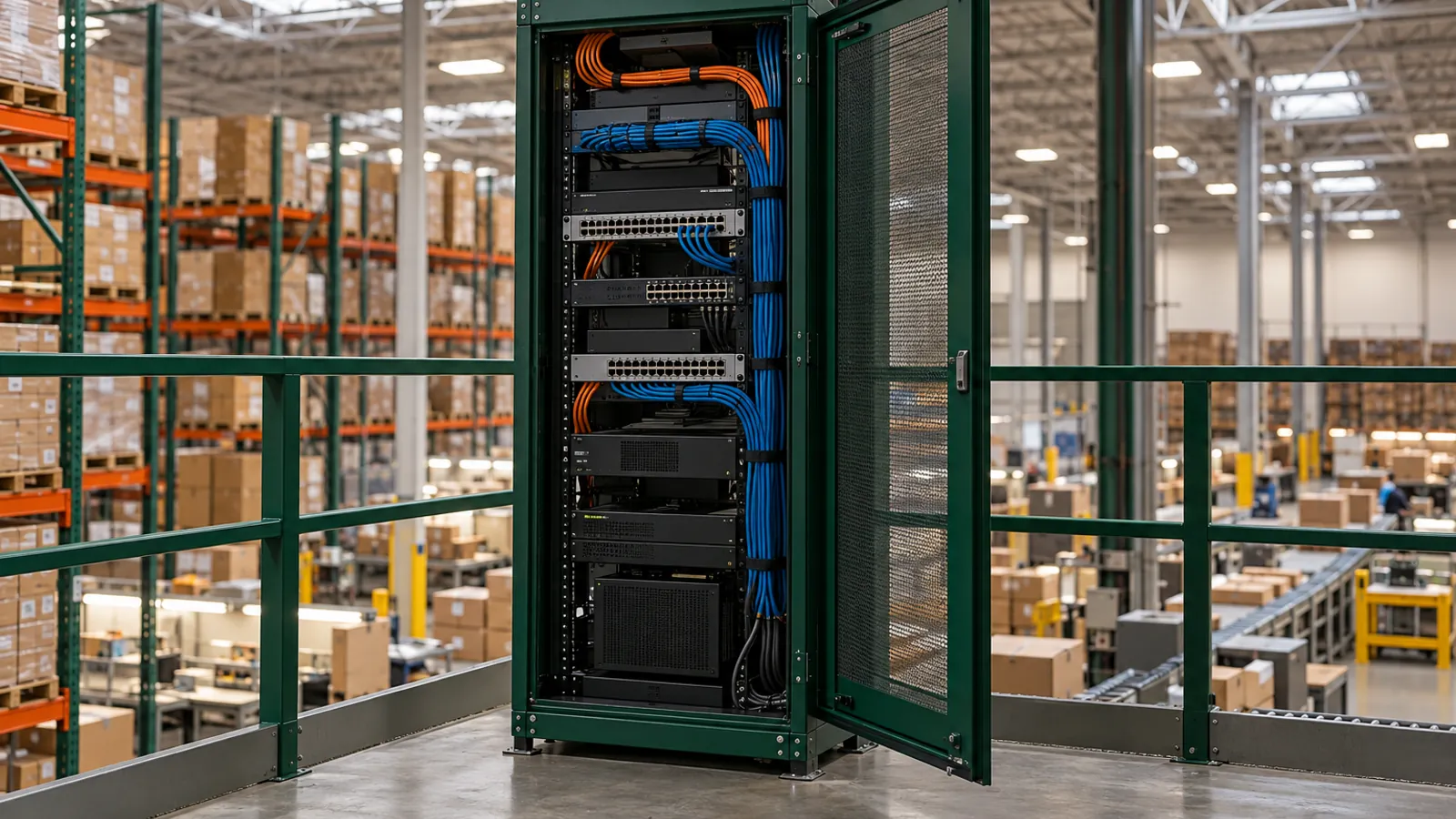
Choose a WMS deployment model by assigning operating responsibilities, not by assuming that cloud means effortless or self-managed means secure. The useful comparison is who maintains the application, infrastructure, access, integration, backups, and recovery process. Document those responsibilities for the exact service proposed, then test whether your warehouse and IT team can perform their part during an outage or change.
Separate deployment from functional scope
Cloud and self-managed describe different operating arrangements, not a guaranteed feature set. Either approach may support a specialist warehouse application or an ERP warehouse module. First define the execution capabilities you require. Then compare how the proposed deployment will deliver and maintain those capabilities. Do not trade away a required lot hold or partial-pick process merely because the hosting model sounds simpler.
A hosted service also depends on local conditions: wireless coverage, handhelds, printers, identity services, and network connectivity. A self-managed application may depend on remote authentication, external carrier services, or cloud integrations. Draw the actual dependency map rather than treating either option as a single box. Include the path from a handheld scan to the stock record and back.
Assign each responsibility
| Responsibility | Question to resolve | Evidence |
|---|---|---|
| Application upgrades | Who schedules and tests changes? | Release and test process |
| Infrastructure | Who patches and monitors hosts? | Named service owner |
| Identity | Who grants and removes access? | Role and offboarding test |
| Backup | What is copied and how often? | Scope and retention record |
| Recovery | Who restores a usable warehouse? | Rehearsal and reconciliation |
| Interfaces | Who investigates failed messages? | Support escalation path |
Do not accept two parties both saying that the other owns an interface. Assign an initial triage owner even when the final fix may belong elsewhere. Ask who coordinates incidents across the WMS supplier, ERP partner, network provider, and automation integrator. Record support hours in the warehouse's time zone, including peak-season and weekend requirements.
Compare recovery, not just availability
Availability describes service access, while recovery also concerns data and operational consistency. Ask how much recent activity could be lost and how long restoration might take under the proposed arrangement. These targets should be written by the parties responsible for delivering them. A service credit is not a replacement for a warehouse recovery plan.
Use an illustrative failure scenario: the application is restored after a disruption, but several cartons physically shipped while confirmations were delayed. The team must reconcile shipments, stock, and messages before restarting. Restoring a database alone does not settle whether those goods are still available. Ask each supplier to explain the reconciliation process and what evidence is retained to support it.
Plan updates around the operating calendar
Ask how release notices are delivered, whether a test environment is available, which integrations require regression tests, and what happens if an update conflicts with a peak period. For self-managed software, budget the people and environments needed to keep versions supported. For hosted software, ask which controls you retain over timing and what notice is contractually provided.
Test representative transactions after changes: receiving, allocation, short picking, packing, shipping, cancellation, and a failed interface retry. Keep expected outcomes beside actual results. An update can be successful at the infrastructure level while a custom mapping or printer workflow breaks. Include local devices and peripheral software in the change inventory rather than limiting it to the main application.
Build the commercial comparison
Compare a common horizon using application fees, infrastructure, administrators, security work, monitoring, upgrades, backups, recovery exercises, and interface support. Do not assume that an internal employee has zero cost because their salary already exists. Estimate the time needed and identify what other work will be displaced. Separate cash expenses from staff capacity in the business case.
Use official cybersecurity guidance to frame questions, not to claim that either option is certified. The FTC's business guidance discusses backups, access protections, and vendor risk; it does not approve an individual WMS. Ask your security lead to assess the proposed service and contract against your obligations. Regulated products or customer contracts may add requirements beyond this comparison.
FAQ
Does a cloud WMS work without warehouse internet?
Only if the specific product and workflow provide a supported offline arrangement. Demonstrate disconnection and safe resynchronization rather than accepting a general promise.
Does self-managed software remove vendor dependence?
No. You may still depend on licenses, supported versions, specialists, and external services. Test your access to documentation, exports, support, and recovery materials.
Which option is more secure?
That cannot be decided from the label. Review the actual controls, responsibilities, evidence, and recovery process for the proposed system and your team.
Continue your decision
- Warehouse management software cost: build a defensible budget — Map subscription, implementation, devices, integrations, and internal work into a comparable WMS budget without invented market prices.
- WMS pricing models: users, orders, sites, and overages — Decode the billing unit in a WMS proposal and test the effect of seasonal peaks, additional sites, and changing user counts.
- ERP warehouse module or standalone WMS: test the gap — Decide whether a warehouse execution gap needs a separate WMS or better use of your existing ERP module with a common demo script.
- Use the launch readiness checklist to connect this guide to a practical planning task.
- Compare WMS approaches before treating a product category as a complete specification.
Sources and scope
Official pages checked on October 30, 2026. The planning procedures, test scenarios, and worked examples are original editorial guidance, not prescribed standards or evidence of product testing.
- SAP — What is a WMS? — General warehouse execution terminology; supplier education, not independent product evaluation.
- FTC — Cybersecurity for Small Business — General business security practices and vendor-risk questions.
- NIST — Cybersecurity Framework 2.0 for Small Business — Voluntary risk-management guidance; not a product certification.